Clicking on the question will take you to the answer.
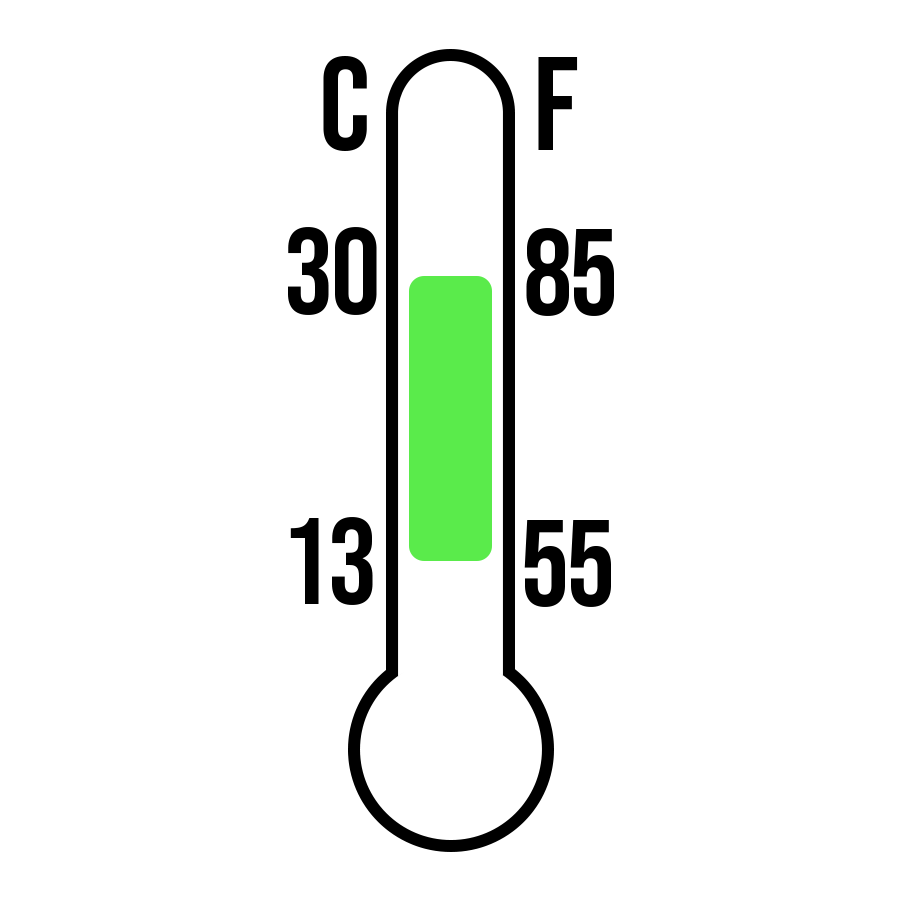
- How do you survive at 13°C/55°F?
- 55°F – Even in the bathroom?
- Why should I go GreenBetween if I heat and air-condition with green electricity?
- Why should I go GreenBetween if I heat and air-condition very efficiently?
- Is going GreenBetween permanent or temporary?
- What generates a tonne of CO2e?
- What is the derivation of the home page statement “Compared to “Heat and Cool to 20C/70F”, “GreenBetween” is roughly estimated to reduce heating and air conditioning carbon foot print by 75% and total carbon footprint by 15%.”?
- Compared to “Heat and Cool to 20C/70F” does GreenBetween require increased attention to indoor humidity?
—
How do you survive at 13°C/55°F? I survive at 13°C/55°F (and often times at 10°C/50°F to reduce my carbon footprint a bit more), by dressing very warm. I wear a long-sleeved polyester-fleece shirt, a light-weight down jacket, a heavy weight winter coat, and a knit hat. When I am sitting at the computer, watching TV, or reading, I often have one or more blankets over my lap and legs. I pile many blankets on my bed to keep me warm at night. I use gloves with exposed fingers and thumbs for computing and reading. This approach does the job for me. If it didn’t, I would resort to one or more of thermal underwear, wool socks inside fur-lined boots, and a second pair of pants. I do use an electric heater to warm the bathroom to about 60°F during the winter, and to about 70°F before I take a shower. Surviving 13°C/55°F is very easy compared to the non-survivable situations that will be caused by failing to take decisive action to reduce carbon footprint. Homelands being submerged by about 66cm/2ft sea-level rise will not be survivable. Temperatures will rise so high that some currently inhabited high-humidity portions of our plant will become non-survivable (the body will no longer be able to cool itself adequately by sweating).
—
55°F – Even in the bathroom? I compromise a bit on the bathroom temperature. I figure the carbon footprint impact is minimal compared to the overall carbon footprint reduction achieved by GreenBetween. I use an electric space heater to temporarily warm the bathroom to 70°F+ before I take a shower. Also, during the heating season I keep the bathroom door closed and use the the electric space heater to keep the temperature about 60°F.
—
Why should I go GreenBetween if I heat and air-condition with green electricity? Go GreenBetween to free up the green electricity to replace non-green electricity. At this point in time, it is highly likely that there are communities on your power grid that are using non-green electricity. The green electricity power that you do not use for heating and air-conditioning can be sold on your grid to be used instead of the non-green electricity, thereby reducing the overall carbon footprint of your power grid. (Western Electric Grid example: https://www.latimes.com/environment/newsletter/2021-04-29/solar-power-water-canals-california-climate-change-boiling-point?utm_id=28229&sfmc_id=4305139) Furthermore, the demands for green electricity will be growing significantly over time as the planet makes the crucial transition away from carbon-footprint-intensive technologies. In some cases, such as battery-based electric vehicles, the green electricity will be needed as a direct replacement for carbon-based fuels. In other cases, such as in the production of fertilizer or hydrogen fuel, the green electricity will be needed to produce the minimal-carbon-footprint alternatives.
—
Why should I go GreenBetween if I heat and air-condition very efficiently? Go GreenBetween because, even though you are heating and air-conditioning very efficiently, going GreenBetween will still likely result in using significant less energy for heating and cooling. For example, assuming you are claiming a 50% efficiency advantage because you use a heat pump, going GreenBetween still likely result in you using significantly less energy for heating and cooling. Go GreenBetween and claim additional carbon-footprint hero points for adding heat pump energy savings on top of GreenBetween energy savings. If you have one of those rare cases where design and technology have been sufficiently applied to allow legacy “heating and cooling to 20°C/70°F” with negligible active energy input, enjoy this rare opportunity, unless you want to claim even more carbon-footprint hero points by going GreenBetween in a show leadership to, and solidarity with, that vast majority of humanity that must go GreenBetween to achieve a minimal carbon footprint.
—
Is going GreenBetween permanent or temporary? Thinking positive, going GreenBetween is temporary – part of the Less Now, More Later big picture mentioned on the home page of this GreenBetween web sote.. Envision a future when the planet is using “all’ green energy and there is excess green energy available for new uses. At that point (20? 40? 60?… 100?… years from now) we can use some of that excess green energy to return to “heating and cooling to 20°C/70°F” – a standard that the vast majority of us would agree makes for extremely pleasant living if humankind has reached the point of being able to do it in a sustainable manner.
—
What generates a tonne of CO2e? These equivalencies will give you a rough quantitative feel for the components of your carbon footprint, but be aware that determining precise values for an individual case is a very complicated process. Derived from https://www.epa.gov/energy/greenhouse-gas-equivalencies-calculator, a tonne of CO2e is roughly equivalent to 113 gallons of gasoline, 99 gallons of oil, 1110 pounds of coal, 1450 kWh of electricity, 19 CF of natural gas, or 190 therms of natural gas. For example, in my case by going GreenBetween I’m using about 500 gallons less heating oil each winter, which means I’m reducing my annual carbon footprint by about 5 tonnes CO2e. (I don’t have air conditioning.) Derived from https://carbonfund.org/calculation-methods/, a tonne of CO2e is roughly equivalent to 5000 passenger air miles. From https://www.timeanddate.com/worldclock/distances.html you can get passenger air miles from your location to other locations and calculate an approximation of the carbon footprint of a flight to one of those other locations. Derived from http://css.umich.edu/factsheets/carbon-footprint-factsheet, and https://www.bbc.com/news/science-environment-46459714, a tonne of CO2e is roughly equivalent to the following number of servings: 339 of beef, 914 of cheese, 1,302 of pork, 1,778 of poultry, 2,517 of eggs, 3,111 of milk, 14,000 of rice, 20,364 of legumes, 32,000 of carrots, or 74,667 of potatoes. Perhaps you can significantly reduce your carbon footprint by modifying your diet, for example replacing servings of high-carbon-footprint meats and dairy with servings of low-carbon-footprint legumes. Note that beef has a particularly high carbon footprint.
—
What is the derivation of the home page statement “Compared to “Heat and Cool to 20C/70F”, “GreenBetween” is roughly estimated to reduce heating and air conditioning carbon foot print by 75% and total carbon footprint by 15%.”? The 75% is nothing more than my personal experience of reducing my heating energy consumption by about 75% by going GreenBetween rather than heating to 70°F. I don’t have air conditioning, and simply assumed the same percentage for air conditioning. The percentages are going to vary from case to case based on factors such as heating efficiency, air-conditioning efficiency, and climate. The 15% is calculated as 75% x 40% x 50% = 15%. Page 28 of the March 2015 edition of the Spectrum magazine of the IEEE (Institute of Electrical and Electronics Engineers) states that in the United States residential and commercial buildings account for about 40% of energy consumption (transportation 28%), and heating and air-conditioning account for 50% of residential consumption. I assumed the same 50% for commercial consumption. I assumed all the GreenBetween energy savings result in carbon footprint reduction, figuring even if going GreenBetween was reducing the use of green energy for heating and air-conditioning, the “saved” green energy would be sold on the grid to be used in place of non-green energy elsewhere. I found Spectrum’s percentages of 40% and 28% to be consistent with https://www.eia.gov/energyexplained/us-energy-facts/ when I distributed the energy losses incurred by the electric power sector to the end-use sectors (transportation, industrial, residential, and commercial).
—
Compared to “Heat and Cool to 20C/70F” does GreenBetween require increased attention to indoor humidity? Increased attention to indoor humidity is recommended during the heating season, especially if you live in a high humidity climate, do a lot of cooking, or have many folks living in your house. Heating air reduces the relative humidity of the air. With heating to 20°C/70°F, your heating likely sometimes reduced the humidity a bit to a desirable level, and other times reduced the humidity a lot to an undesirable level, sometimes with symptoms such as an annoying static spark that jumps from your hand to the door knob as you reach to open the door. A disadvantage of high humidity air relative to low humidity air is that high humidity air is more likely to support the growth of mold. Monitor the humidity of your indoor air (can be done with a very inexpensive sensor, sometimes combined with a simple thermometer), and run a dehumidifier if needed to pull the humidity down to a reasonable range. I’ve been using 60% relative humidity as the trigger level at which I turn on my dehumidifier. A fraction of your savings in heating costs from going GreenBetween can be used to purchase a dehumidifier, and the “waste” heat from running the dehumidifier can provide a portion of your indoor heating.
Facebook – Twitter – Instagram – YouTube – Email
Thanks to <tbd>, the current sponsor of this website.
 GreenBetween to Combat Global Warming